
Whether you’re hiking alone in the countryside or taking a casual walk with good friends, you can easily use an app to record every bird you see or hear along the way. Taiwan’s app portal for “eBird”, the world’s largest bird database, has recently celebrated its 10th anniversary. It has surpassed over 10,000 users, and accumulated millions of birds’ data through public birdwatching. At the recent eBird Asia Strategy Meeting in South Korea, Taiwan’s vast bird information shone brightly on the global map.
How Birdwatchers’ “Lit Up” East Asia
Starting from 2015, Taiwan Wild Bird Federation (中華民國野鳥學會) has collaborated with the Taiwan Biodiversity Research Institute (農業部生物多樣性研究所, previously the Endemic Species Research Center) to launch the eBird Taiwan portal.
This portal not only provides birdwatching enthusiasts with a place to share and manage their bird observation records, but also features countless scientific research, educational, and conservation cases. eBird Taiwan utilizes a large amount of data, including assessments of The Red List of the Birds of Taiwan (臺灣鳥類紅皮書),The State of Taiwan’s Birds(臺灣國家鳥類報告), and the ongoing Taiwan Bird Atlas(臺灣鳥類地圖).
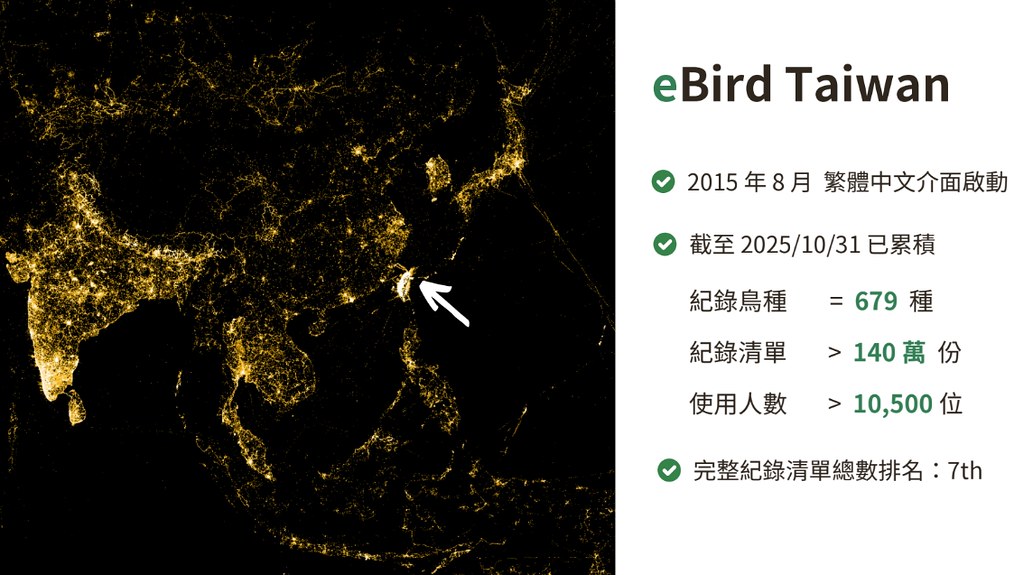
To date, eBird has over 1.18 million users worldwide, contributing over 110 million records and 1.7 billion sightings in total. eBird Taiwan's user base just surpassed 10,000 in June of last year, accumulating 17.5 million records and covering 679 bird species through enthusiastic recording.
The total number of records accumulated from each birdwatching session has reached 1.38 million, making Taiwan the seventh-ranked country globally in birdwatching records. This spontaneous recording of birds has encouraged the public to become citizen scientists.
At the eBird Taiwan 10th Anniversary Press Conference last November, Lin Ruey-Shing (林瑞興), Division Chief of Ecosystem Management at Taiwan Biodiversity Research Institute, had just returned from attending the eBird Asia Regional Strategy Meeting in South Korea.
He mentioned that the abundance of information at the conference made Taiwan shine in East Asia. International friends who were previously unaware of Taiwan's location were not only full of praise but also remembered Taiwan. "We have every reason to be proud of our country."
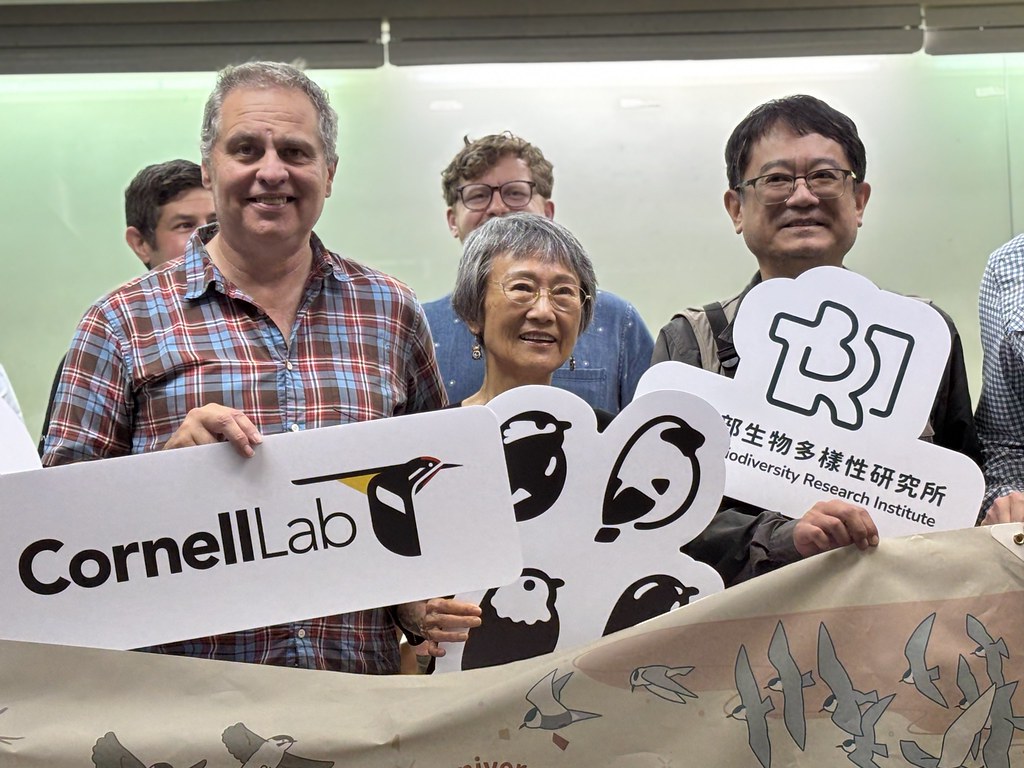
Following the eBird Asia Meeting in South Korea, Dr. Ian Owens, Executive Director of the Cornell Lab of Ornithology at Cornell University, visited the Taiwan Wild Bird Federation and toured the island to learn about its birdlife.

Owens Praises Taiwan’s High-Quality Data Contributions
At the press conference, Owens affirmed the active participation of Taiwanese citizen scientists, considering Taiwan an outstanding example of the eBird community. "Behind these amazing figures is an extraordinary team, and thanks to their efforts, Taiwan possesses some of the world's best environmental data."
When asked whether global bird conservation receives sufficient attention, Owens stated that conservation must be data-driven, relying on objective facts to help develop effective strategies. He noted that Taiwan's eBird platform has earned recognition and admiration from other countries because of high data quality and quantity from the island. He hopes that the establishment and use of this system will encourage, inspire, and move the public, creating an impact that fosters a willingness to engage with and understand nature, thus deeply embedding conservation in people's hearts.
How AI Empowers Citizen Science: Bird Sound Recognition
Cultivating citizen scientists has been a long-standing strategy of the Taiwan Biodiversity Research Institute. Director Yang Jia-Dong (楊嘉棟) stated that before conserving biodiversity, it is essential to take stock of the nation's assets.
However, this massive undertaking cannot be accomplished by government departments or research institutions alone. The participation of citizen scientists is indispensable, especially in bird surveying and documentation.
Yang Jia-Dong pointed out that these achievements are attributable to the strong partnerships between the Taiwan Wild Bird Federation and other national bird societies. Even veteran birdwatchers have contributed years of their birdwatching notes and data, demonstrating the value of cross-sectoral collaboration.
"It is your passion that keeps Taiwan's bird ecology map shining brightly." Yang Jia-Dong expressed his heartfelt hope for another ten years of collaboration, aiming for this beautiful island, Taiwan, to become one of the brightest stars in the world of biodiversity.
The Cornell Lab of Ornithology has another powerful online digital bird catalog, the "Merlin" (common name for the Grey-backed Falcon, 灰背隼) app. In recent years, it has been training artificial intelligence (AI) by inputting bird sound data from bird experts from various countries.
As for Taiwan, through TSMC's "Eco Plus! Ecological Harmony Program," the Taiwan Wild Bird Federation, has built a bird sound archive for native birds, which can currently identify 250 local bird species.
Chang Jui-lin (張瑞麟), chairman of the Taiwan Wild Bird Federation, stated that over the past year, the Federation has actively trained eBird users across Taiwan. This training included holding numerous online lectures and providing on-site training to familiarize birdwatchers with the eBird system, aiming to enhance survey capabilities. In addition to this training, Chang also encouraged birdwatchers to use the well-established Merlin platform for more accurate bird identification.
Starting in 2024, the "Eco Plus! Ecological Harmony Program" has been providing data to the "Taiwan Bird Atlas" to monitor the status of breeding birds and provide more accurate information on species distribution. It is expected to be completed by 2028.
Protecting Threatened Species: Cracking Down on the Usage of Birding Tools
Could such a useful birdwatching tool contribute to bird poaching? Lin Ruey-Shing pointed out that at the eBird Asia Meeting, countries with relatively serious bird poaching problems also expressed similar concerns, believing that the use of such tools needs careful evaluation.
In Taiwan, with improved socio-economic conditions, bird poaching has decreased significantly. It is large gatherings of spirited bird enthusiasts, however, that cause major disturbances. Instead, these gatherings—often due to rare bird sightings—must be addressed to preserve the sighting landscape.
Participants unanimously pointed out that Taiwanese society's demand for open and transparent information has ironically spurred public oversight; therefore, when inappropriate or unethical behavior occurs, it is reported relatively quickly.
Furthermore, eBird's design identifies potentially risky species—those subject to capture stress, habitat destruction, or disturbance due to large gatherings—as sensitive species, making them difficult to find on the map or providing vague or unclear information.
Liu Hsiao-ju(劉小如), a long-term ornithologist, now retired researcher at Academia Sinica, has praised the bird data contributions of Taiwanese birdwatchers. Regarding the future of ecological conservation, she believes that Taiwan is making rapid progress. Although many conservation efforts clash with business interests, people are starting to realize—due to recent environmental changes and easily accessible information—that the environment can no longer be ignored.
eBird is a birdwatching record platform established in 2002 by the Cornell Lab of Ornithology. Initially, the platform focused on the needs of birdwatchers in North America, but in 2010 it expanded its scope to include birds worldwide.
Translated by Jaye Brayboy.